
Why bother?
It's been a rough year if you care about democracy. I was reminded recently—at a funeral, of all places—that it's worth staying in the fight.

Notwithstanding some good news yesterday, if you’re someone who thinks that gerrymandering is bad, it’s been a rough couple of months.
I’ve written extensively about gerrymandering before—not just because my own run for Congress ended in ’22 because of gerrymandering—and why it’s bad for everyone in America.

But what we’re experiencing now is much worse than anything in modern American history. Republicans will favorably redraw more seats than Democrats ahead of the ’26 midterm elections, though I still think Democrats will win the U.S. House.
The long-term prognosis concerns me much more: vanishingly few competitive seats, perpetual gerrymanders, and more extreme politics. All of this had me feeling quite pessimistic: what’s the point?
As some of you may know, Ray Hartmann—a longtime figure in St. Louis media and politics—died last month in a freak car accident.
I went to his funeral in the throes of some rather intense nihilism at all the gerrymandering and at the state of our politics, and I was reminded of something important: America is deeply flawed and imperfect, but cynicism gets us nowhere. It’s still worth fighting for what’s right.
Article summary:
Perpetual gerrymandering is here. It’s not obvious to me which party will “win,” but it is obvious that the American people will lose.
Ending partisan gerrymandering is overwhelmingly popular. We’ve pulled off much more challenging democracy reforms before, and unlike changes in the past, fixing this only requires an act of Congress, not a constitutional amendment.
Ray Hartmann was difficult, loud, and committed to justice
I didn’t know Ray particularly well, but we did have a lot in common.
Most notably, we both tried (and failed) to unseat Ann Wagner in Missouri-02. Missouri Democratic politics is a small world and we would run into each other periodically. When I ran for Congress, he was kind to me when he didn’t have to be, making intros and having me on his radio show a couple of times.
If variety is the spice of life, Ray was a Carolina Reaper.1 He was a speechwriter for Kit Bond; he ran two different publications, the Riverfront Times2 and St. Louis Magazine; he spent a few decades yelling on Donnybrook; he started a family around the age of 50 and had two kids; he went bankrupt; he ran for Congress; he had all sorts of (mis)adventures.
I’d known most of this before I went to the funeral. What I hadn’t known was that his mom, as a nine-year-old, left Nazi Germany with the support of the German Jewish Children’s Aid program. Ray’s aunt, grandmother, and grandfather were all murdered in Auschwitz. But his mom survived because a family in University City took her in.3
His family history is a testament to humanity’s capacity for evil, and also what America can be at its best.
Growing up with a mother whose family had been murdered instilled in Ray a desire to fight for justice. As every eulogist noted—including his children—he was an ideologue, unwilling to back down when he believed he was right. That’s how you end up running for Congress in a seat you know you’re going to lose.
Politics is full of people who flap in the wind to keep their jobs, to survive another election.4 Ray Hartmann ran for Congress because he truly cared. He really wanted to engage with voters; he really wanted to change people’s minds. Ray wasn’t upbeat, but insofar as he believed he could make things better, he was an optimist.
Here’s why I’m bringing this up: amidst all the attacks on our democracy, it’s hard to have that optimism.
Below, I’ll walk through where all of this gerrymandering is headed. But I’ll end on a positive note: change is possible. We’ve realized more difficult reforms before, including ones that were much more outlandish in the context of their time.
We have something to learn from Ray’s brand of hopefulness.
Who cares about persuasion when you can change the ground rules?
Once you start to grapple with the scale of what’s happening right now, it’s easy to let the despair set in.
92% of U.S. House races are functionally decided in the primary. That number will likely go up after the ’26 elections, because more states will draw away swing districts and districts whose partisan lean they don’t like.
This redistricting stuff changes all the time—much more in the footnotes5—but there’s a chance that as many as 68% of the states that have the structural ability to gerrymander themselves do so.6 This is imprecise and subject to change, but it’s a fairly maximalist look at what could happen by the 2028 elections:
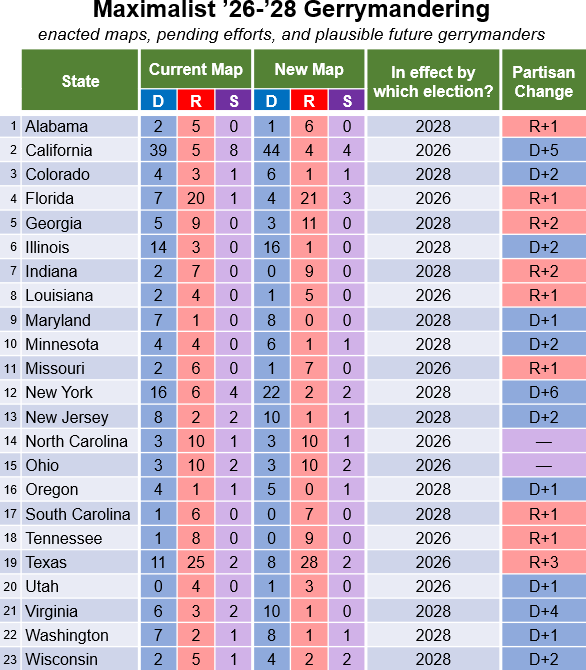
It’s the sort of thing that makes politics feel pointless; why bother with ideas or persuasion when we can just draw the districts we like?
The chart above undercounts Republican gains, because a lot of the swing seats here—in Florida, North Carolina, Ohio, and Texas—are still Republican-leaning, and are really only flippable with the best candidates and under the best conditions for Democrats.
There’s also a decent amount of guesswork; legislative negotiations can be black boxes, especially at the state level where there isn’t much local media coverage.
In any event, the scale of this is unsettling, and we’ve opened Pandora’s Box. Unless something changes, we’re barreling towards a universe where gerrymandering will happen every two years. Don’t like what happened in the last elections? Just tweak the lines; that’ll solve it.
My best guess, looking ahead to the 2028 elections, is that neither party will gain a huge edge. If anything, I can see a world where Democrats give themselves an edge in the House.
But this is all really, really bad. When the parties are truly competitive, they have to change and adapt. They have to meet voters where they are. The more we gerrymander, the more extreme parties become, and the more elected officials only have to worry about primary voters.
I’ve felt plenty nihilistic about all of this.
So with all of this happening, why bother?
Against almost impossible headwinds, extraordinary things are still possible. Women won the right to vote without even having the right to vote. So did Native Americans and African-Americans.7 When I was in high school, the idea that gay marriage would be legal was a pipe dream. Proposition 8, a ban on gay marriage, passed in California in 2008, which is crazy to think about.8
Ending gerrymandering is comparatively simple. It doesn’t require a constitutional amendment, merely an act of Congress. And unlike the changes above, it starts out from a much different baseline: an overwhelming majority of Americans of all stripes believe that partisan gerrymandering is bad.

Cynicism is easy. Optimism requires work. But in this case, it helps that the American people are in agreement.
The solution here will have to come at the federal level; when states act alone, it’s a race to the bottom. But we can fix this—perhaps not overnight, perhaps not with this Congress, but Americans have overcome much larger obstacles.
What makes this issue tricky is that it requires politicians to vote against their self-interest. Even then, when the groundswell is substantial enough, elected officials have voted against their self-interest before, for instance:
Passing the Seventeenth Amendment.
It doesn’t happen immediately, but elected officials are responsive to what voters want, however imperfectly.
And that’s the hope I carry with me from Ray’s memorial service. Hopeful that there is a way to make things better. Hopeful that there are candidates who still want to run for office to change minds and persuade people. And hopeful that there are people like Ray out there in the world: hard workers, loud critics, and contrarians, truly dedicated to what’s right.
Feel free to share this post with someone who will find this interesting. If you’re reading this email because someone sent it to you, please consider subscribing.
Ann Wagner, Ray would want me to say, is about as flavorful as mayonnaise. And she still hasn’t bothered to update her campaign website from 2024, which tells you how unseriously she’s taking this next election.
Which is now, after having been sold again, a content farm for OnlyFans. So if you want to find the Hottest Lithuanians on OnlyFans in 2026, the Riverfront Times has you covered. (I’m not going to link to this, but I promise you that’s a real page on their website. Look it up if you must; the page itself is SFW.)
Ray’s mom and uncle, who also relocated to Missouri in the mid-’30s, were part of a cohort that later became known as the One Thousand Children.
You see that with people like U.S. Senator John Cornyn, who badly lost in his Republican primary last night. He used the valuable time and resources of his office to write legislation that would name a highway after Donald Trump, purely for the purposes of getting an endorsement he didn’t get, purely so he’d win an election he didn’t win.
Talk about squandering a chance to truly serve the public.
A whole bunch to explain here. Structurally, I used either the current Cook Political Report or the April 2025 vintage of the Cook Political Report to determine what constitutes a swing seat. In both, I’m counting swing districts as anything that Cook says is either “Toss Up,” “Lean D,” or “Lean R.”
The result of that is that this chart overstates the count of Democratic gains. A lot of the seats that have recently been redrawn/gerrymandered are right at the cusp of a safe Republican seat and a competitive-but-Republican-leaning seat—there are a few examples of that in Florida, North Carolina, Ohio, and Texas. Moreover, these seats might only be competitive in a year that’s shaping up to be bad for Republicans; in other years, they might not be swing seats at all.
Anyway, this chart is—at best—an informed estimate, not science. The real numbers will vary considerably. The other dynamic at play is that while Democrats will try to gerrymander the states they control—New York, New Jersey, Washington, etc.—it’ll take a lot more doing than in Republican states, where the legislatures and governors can more or less do it themselves.
A bunch of other notes on individual states:
Alabama: Despite the news I shared at the top of the article, my guess is that Alabama will eventually succeed in further gerrymandering its Congressional map, though that may not happen until the ’28 cycle.
Colorado: It would require the voters to approve a change to the state’s redistricting commission, but that feels possible if not likely at this point.
Florida: Their gerrymander seems plainly unconstitutional by the state’s prohibition on overtly partisan redistricting, but I sincerely doubt the courts will intervene. Early indications certainly suggest that they won’t.
Georgia: They’re taking steps to redraw their maps ahead of 2028. Even if Keisha Lance Bottoms wins the gubernatorial election this fall, I don’t think Democrats will be able to do much to stop this.
Indiana: State Republicans stood up to the Trump administration earlier this year, and it cost a bunch of them their jobs. Will they have a spine when they try again in a year or two? I doubt it.
Minnesota: It’d require Democrats to win the State House and retain the Senate, but I think given the way the year is shaping up, that’s a pretty good bet.
Missouri: Thanks to Denny Hoskins—an all-around weird guy, to say nothing of the fact that he plainly doesn’t do his job—who knows if the citizen-initiated repeal of the state’s gerrymander will even end up on the ballot. If it succeeds, I wonder whether the state legislature will turn around and just do the same thing in ’27. Feels like an endless game of cat-and-mouse.
Utah: My guess is that, one way or another, state Republicans find a way to win the fourth seat back.
Virginia: Same deal: my guess is that Democrats find a way to carve up Virginia.
Wisconsin: Who knows, but with greater control of the courts, and an outside chance to flip the legislature, Democrats could very well pick up a few seats there.
Bear with me on the math here. When I say structurally possible, what I mean is that states that have one Congressional seat can’t gerrymander themselves (there’s nothing to gerrymander) and states with two Congressional seats have a much trickier time doing it (there’s only one other district to displace voters).
That’s a bit of an oversimplification, I’ll note. In New Hampshire, it’d be possible to draw one Republican-leaning district and one very Democratic district, rather than two slightly Democratic districts. In Maine, you could take one very Democratic district and put some of its voters into the state’s Republican-leaning 2nd District to make it more competitive. But it’s a lot trickier and riskier.
So I removed 13 states in all that have one or two Congressional districts: Alaska, Delaware, Hawaii, Idaho, Maine, Montana, New Hampshire, North Dakota, Rhode Island, South Dakota, Vermont, West Virginia, and Wyoming.
To get to 25 states (rather than the 23 on this chart), I’m including two others: Kentucky and Kansas. If both states pick up Republican governors, which is quite possible, I think both will try to redraw their lines. It was too big an “if” to include them in the chart above but it’s certainly possible.
That’s how we get to 25 ÷ 37 = 68%.
Of course, even these victories weren’t without hurdles. African-Americans technically had the right to vote since the Fifteenth Amendment, but in many states, they didn’t have the right in practice. And of course, states still put up barriers for Native Americans and African-Americans to vote.
And this is before you get into true policy successes. For example: over the last 60 years, we’ve cut the smoking rate in this country by about 75% despite the best efforts of the tobacco industry, saving eight million lives from lung cancer and other related diseases, and extending tens of millions more.
At least in Louisiana. In other states, term limits were implemented by citizen-initiated ballot measures.